A CPLM keeps the standard LM head and adds a Copy-Paste (CP) head next to it. The CP head scores every
earlier position with a query and key projection of the final hidden states, as in self-attention. It then turns
those scores into a distribution over tokens by summing positions that hold the same token.
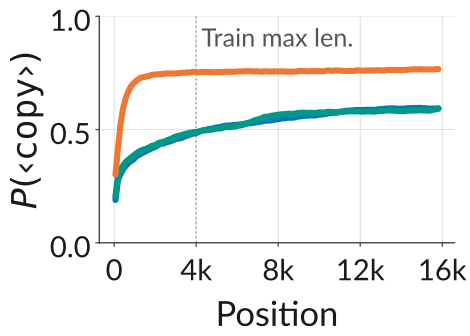
The LM head decides when to copy, through a dummy <copy> token in its vocabulary
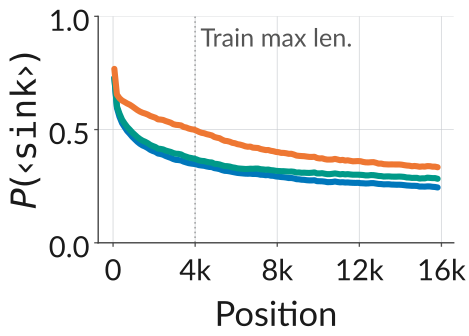
(gate ct). A learnable <sink> key lets the CP head
hand control back to the LM head (st) when nothing in context is worth copying.
Training uses plain next-token cross-entropy, with no auxiliary loss and no copy supervision. The CP head adds
two D×D matrices, which is 0.5% of the parameters and 3% of the compute at 1.7B.
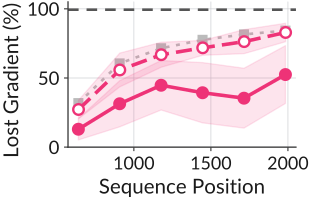
Why it helps. The LM head squeezes a V-dimensional logit gradient through a D-dimensional bottleneck
and loses over 99% of it. The CP head's output space is the t context positions instead of the vocabulary,
which opens a second, much wider gradient path into the backbone.